ServicesConcrete Courtyards
Concrete Courtyards in Long Beach
A courtyard is enclosed, so the concrete has to handle water, access and appearance more carefully than an open yard. We plan the slope and drains first, then the finish, and we tell you plainly what drives the price before anything is ordered.
What a courtyard slab needs that a patio doesn't
Walls on three or four sides change the job. Rain and hose water can't simply run off the edge, so the slab needs a steady fall toward a drain or an opening, set before the first form board goes down. Get that wrong and you get puddles against the house and stains along the stucco.
Courtyards are also seen up close, often from several rooms. That makes the finish and the joint layout matter. We line control joints up with doors, columns and wall corners so the cracks concrete wants to make land where they look intentional.
Many of the Spanish Revival and bungalow homes around Long Beach were built around a courtyard, and a new slab can suit that architecture with a sand finish or integral color. We've been pouring flatwork here for more than 15 years, and courtyards remain some of the most careful work we do.
What the work includes
- Drainage planned first
- We shoot grades, find where water should go, and set area drains or a channel drain where the slab needs one. You see the plan before we form.
- Removal and subgrade prep
- Old concrete, pavers or soil come out, and the base is compacted. Expansive clay is common in the area, so we pay attention to moisture and compaction under the new slab.
- Reinforcement and forms
- Rebar or wire is set on chairs so it sits inside the slab, not at the bottom. Forms are held tight to walls with expansion material where concrete meets the house.
- Your choice of finish
- Broom, sand, salt, exposed aggregate or integral color. If you want a patterned surface, our stamped concrete page covers that option in detail.
- Joint layout you can live with
- Saw cuts or tooled joints are placed to follow the geometry of the space, spaced so panels stay roughly square.
- Protection and cleanup
- Walls, doors and plantings are covered during the pour, and we haul away debris and wash down the work area when we finish.
Signs it's time for a new courtyard
Water sits after rain
Puddles that linger a day or more mean the slab has lost its fall, or never had one. Replacement lets us set the slope correctly.
Stains climbing the walls
Dark lines or flaking paint at the base of the stucco often trace back to water held against the wall by the slab.
Lifted or sunken panels
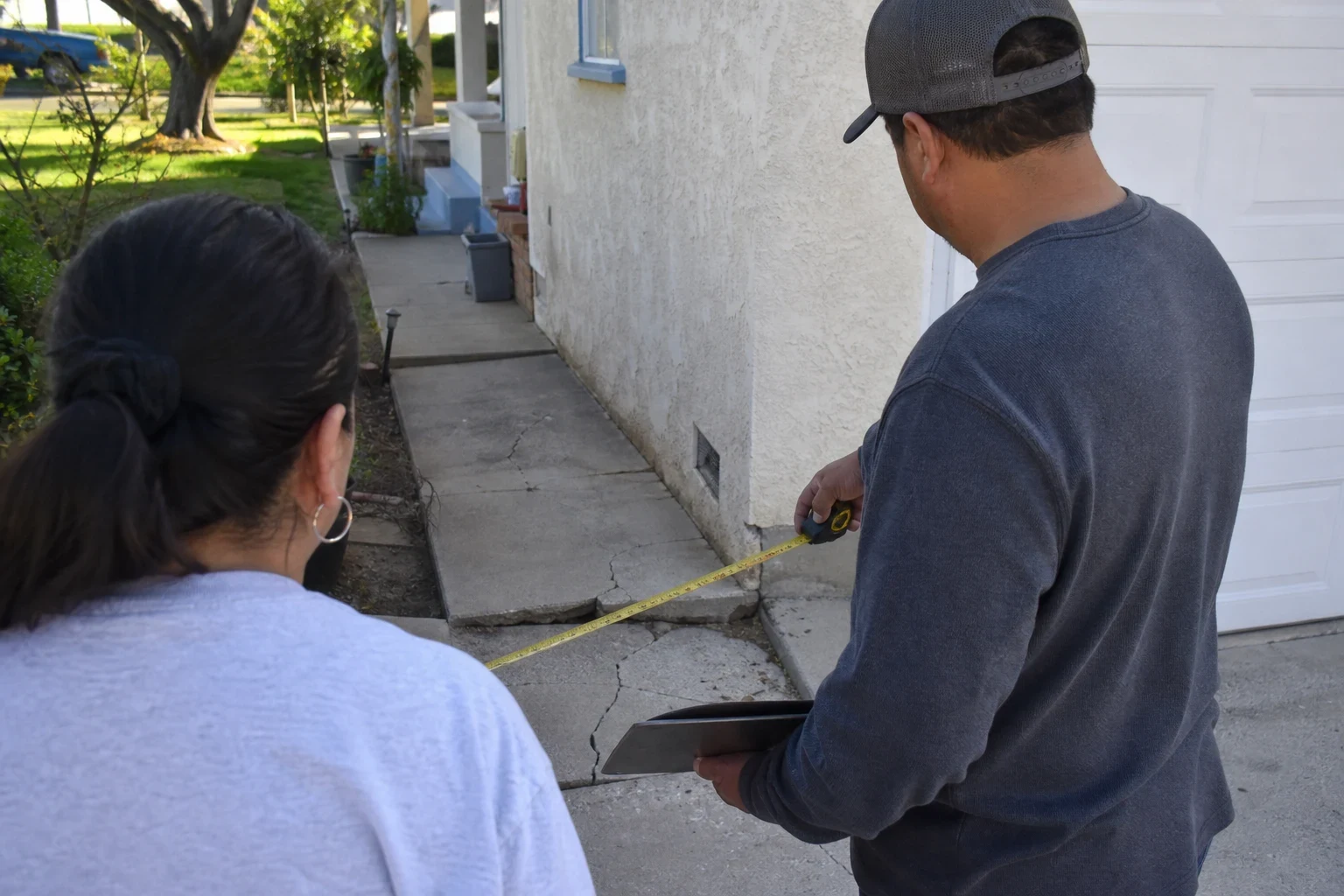
Trip edges at doorways or around trees are a sign the base has moved. A new slab on a properly prepared base fixes the cause.
A surface you've stopped using
Worn, patched or mismatched concrete can make a courtyard feel like a passage. A new finish can turn it back into a room.
Pavers or dirt you're tired of
Weeds in joints, uneven pavers or bare ground that tracks indoors are all good reasons to pour a clean slab.
What moves the cost of a courtyard
Courtyards often cost more per square foot than an open patio because of access and drainage, not the concrete itself. Here is what changes the number most. We'll walk through each one when you call.
Access to the space
If a truck can't reach, concrete goes in by pump or by hand. A pump adds a line item, while hand work adds labor time.
Drainage work
Area drains, channel drains and the pipe that carries water out to the street or a planter add material and trenching.
What comes out first
Thick old concrete, pavers on a deep base, or roots all affect demolition and haul-off.
Finish and color
A broom finish is the simplest. Integral color, exposed aggregate and stamped patterns each add material and finishing time.
Shape and detail
Curves, steps down from a doorway and borders around planters take more forming than a simple rectangle.
How the job runs
- 1
Walkthrough and measure
We look at the space, the access route and where water drains now. You get a straight answer on what's needed and what isn't.
- 2
Written estimate
Line items for removal, base, reinforcement, drains and finish, so you can see where the money goes and adjust choices.
- 3
Demo, grade and form
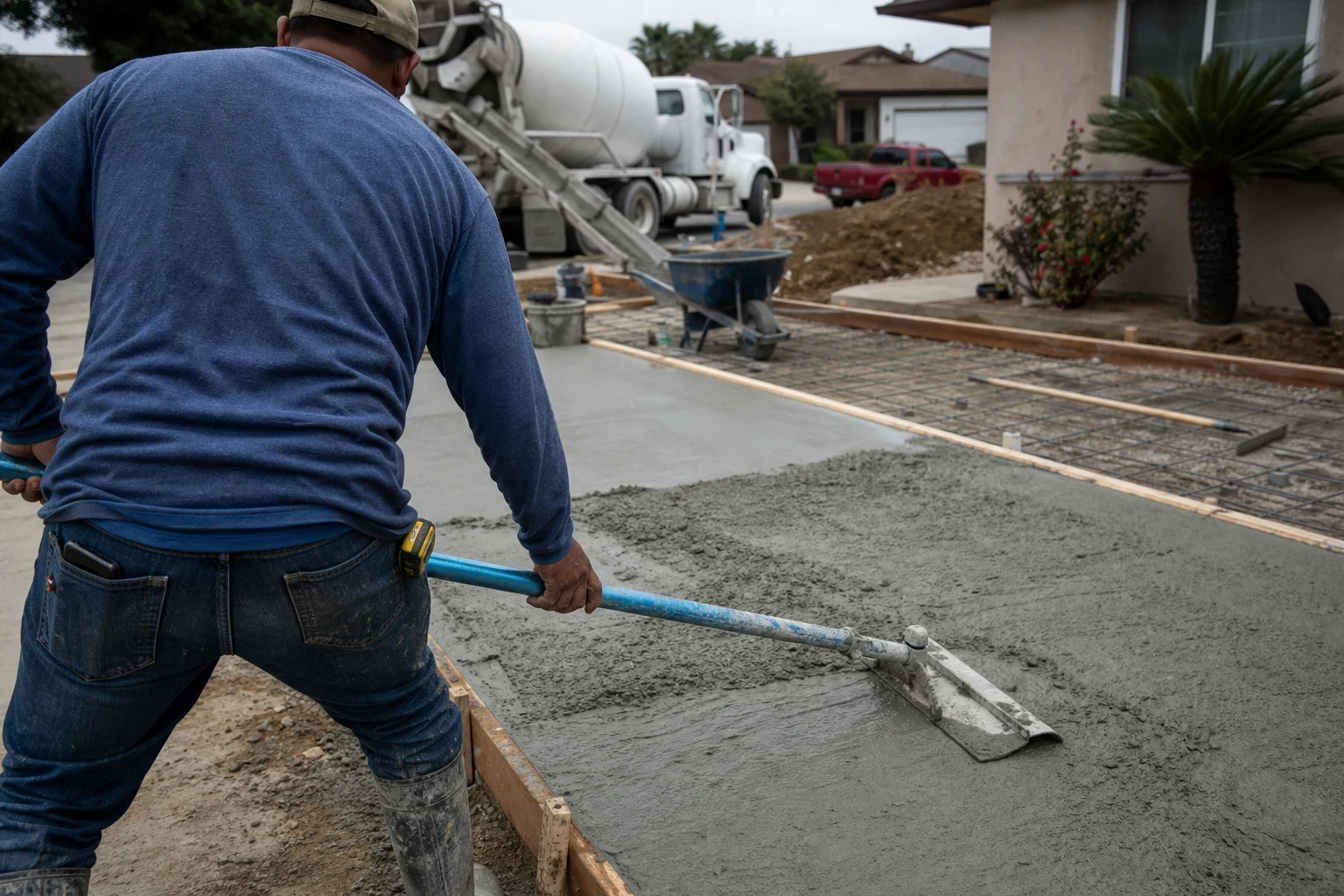
Usually one to two days. We set drains and forms, and you can check the slope and joint plan before the pour.
- 4
Pour and finish
Concrete arrives by truck and, in most enclosed courtyards, travels in by pump line or wheelbarrow through a gate. We finish in one continuous session.
- 5
Cure and handover
Stay off it for about a day on foot and keep furniture off for roughly a week. The work carries our 1-year warranty.
Courtyard questions
Will a courtyard slab need a permit in Long Beach?
Many flatwork jobs don't, but some do, especially when drainage connects to the street. We check what applies to your project and tell you before work starts. If a permit is needed, we include it in the estimate.
How do you keep water away from the house?
We slope the slab away from the walls toward a drain or an outlet, usually a small, steady fall you won't notice when walking. Expansion material separates the slab from the house so the two can move independently.
Can you pour if the only access is a narrow side gate?
Yes. Most enclosed courtyards are poured with a pump line run through the gate or side yard. We protect the path along the way and clean it afterward.
Will the new concrete crack?
All concrete can develop small shrinkage cracks. Good base prep, reinforcement and well-placed control joints keep those cracks tight and where they belong. We'll show you the joint layout before we pour.
What credentials stand behind your courtyard work?
Our company is licensed by the California State License Board (CSLB). We've been in business 15+ years, pouring courtyards, patios and walkways across Long Beach and nearby towns like Signal Hill and Lakewood.
Ready to plan your courtyard
Tell us about the space, how you get into it and how you want it to feel. We'll explain the options and what each one costs to build.